


Volodymyr Zelensky has moved this Wednesday to end the war with Russia by presenting a peace plan with 20 points in which, for the first time, opens to withdraw its troops from Donetsk controlled by Ukraine and create a demilitarized zonea.
A draft of a peace agreement that, despite being the most beneficial for Russia presented so far, Putin does not intend to accept it.
And it is that The Russian leader not only fights a battle against Ukraine, but also against reality itself. He is convinced that he can win the war thanks to the optimistic reports of Russian advances transmitted to him from his military leadership.
As reported this week by Financial TimesWestern officials believe that Putin is systematically being fed fiction about the situation on the battlefield by its own generals and security services.
A mirage made up of inflated victories, imaginary gains and disguised defeats that has convinced the Russian president that he can still win the war resoundinglywhich leads him to systematically reject any peace proposal that, rationally, favors Moscow more than the battlefield.
He Financial Times illustrated this lie in which Putin lives installed with a example that borders on the grotesque. At the end of November, Colonel General Sergei Kuzovlev informed the Russian president that Russian forces had “completed the liberation of Kupiansk,” a strategically important city in the Kharkiv region. Putin rewarded him with the Gold Star, Russia’s highest military honor.
Three days later, Zelensky himself appeared in a video on his social networks recorded at the entrance to Kupianskdestroying the story that Russia controlled the city.
The distortion is such that even Russian pro-war bloggers, generally loyal to the cause, have begun to criticize the glaring gap between official statements and reality.
Slow progress on the battlefield
Faced with Putin’s optimistic vision, Russian advance in Ukraine during 2025 has been slow and costly, maintaining the logic of war of attrition that was already consolidated in 2024, but with a rate of territorial gain clearly lower than that of the first months of 2024.
Although M.Osku has achieved some symbolic city in Donbas at the end of the year, como Siversk o Pokrovskthe front has barely moved a few tens of kilometers in the sectors where Russia pushes most strongly. The result is a campaign where progress continues, but at such a gradual pace that it does not decisively change the strategic balance.
In 2024several analyzes highlighted that Russia had multiplied by six the terrain conquered compared to 2023with around 2,700 to 4,000 square kilometers gained at the cost of enormous casualties, especially in eastern Ukraine.
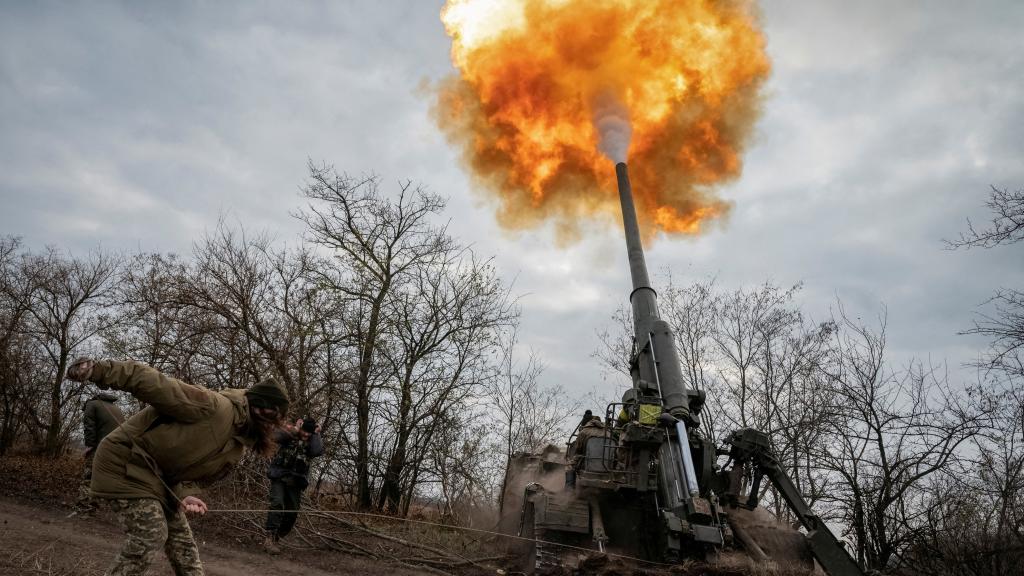
Ukrainian soldiers fire a gun in the Kherson region.
However, even then there was talk of “incremental” advances, based on taking fields, small towns and trench lines, not large cities or entire regions.
Esa dynamic has continued into 2025, but at an increasingly slower pace: for example, estimates such as those from DeepState and the British Ministry of Defense show how the square kilometers captured per month fall from more than 300 to just over a hundred starting in March.
The slow progress of 2025 is explained by several factors: the consolidation of strong Ukrainian defenses, the massive use of drones and artillery by both sides and the increasing difficulty of Russia in sustaining continuous offensives without increasing its losses even further.
Although Russia has maintained the initiative in several axes – Donetsk, part of Zaporizhia and the area around Pokrovsk – many recent offensives are described as attacks that “make no confirmed advances” or only produce slight shifts of the front.
Compared to 2024, 2025 reveals a Russian army still capable of advancing, but trapped in a war of attrition in which each kilometer gained costs time, material and personnel in very high proportions.
kyiv’s latest proposal
This Wednesday, Zelensky presented for the first time in detail the 20 points of the peace plan that kyiv and Washington have developed and has reiterated its willingness to reach a territorial compromise in Donbas, one of the points that remain open.
The 20 points of the plan pose a non-aggression pact between Russia and Ukraine, which would be supervised by a monitoring mechanism and based on a series of security guarantees, such as a Ukrainian army with 800,000 troops and binding agreements under which the US and other allies would commit to providing defense equivalent to NATO’s Article 5.
Regarding the thorniest question, the territorial transfers that Russia claims, Zelensky acknowledged that there are currently two options on the table, of which kyiv prefers the first, which would involve freezing the current front line.
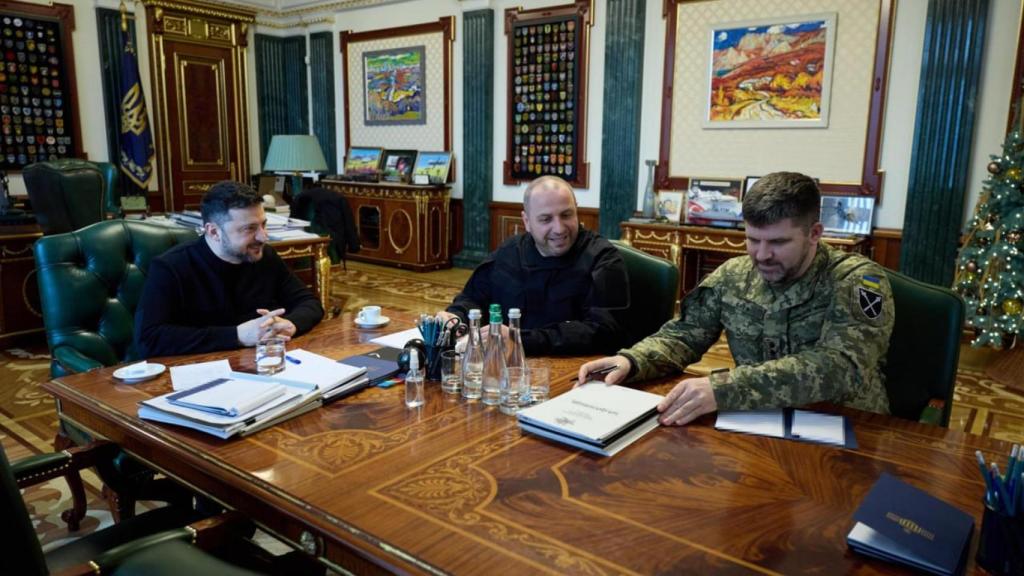
Ukrainian President Volodymyr Zelensky met on Tuesday in kyiv with the Secretary of the National Security and Defense Council of Ukraine, Rustem Umerov, and the Chief of the Ukrainian General Staff, Andri Gnátov.
Efe
The second would involve the creation of one or several economic zones in the part of the Donetsk region that Ukraine still controls but that Moscow claims, something that would however only be studied once kyiv has received sufficient security guarantees.
“If this decision is made, a separate agreement will be signed between Ukraine, the United States and Russia that will determine the status of the special economic zone and the steps that the two parties to the conflict will take in an equivalent manner to withdraw their forces,” Zelensky explained.
The special economic zone It would be administered by Ukraine, even if its troops withdrew, and international forces would have to be present to ensure that “neither ‘little green men’ nor Russian military personnel disguised as civilians” enter, Zelensky warned.
Furthermore, a decision of this type, which implied the withdrawal of troops from Donetskcould only be legitimized by a referendum.
On the other hand, the 20 points do not contain any reference to kyiv’s ambitions to join NATO and Zelensky stated that this issue can only be decided by the members of the Alliance themselves, who for the moment do not wish to admit Ukraine.
According to the Ukrainian president, it is possible that NATO and Russia negotiate separately about the future of their relationship, but that Ukraine itself will not give up its “decision” to aspire to membership, although at the moment it is not realistic.